thusly/thus
“Thusly” has been around for a long time, but it is widely viewed as nonstandard. It’s safer to go with plain old “thus.”
Tuesday, September 30, 2014

Monday, September 29, 2014
under weigh/under way: Common Errors in English Usage Entry for Monday, September 29, 2014
under weigh/under way
The original expression for getting a boat moving has nothing to do with weighing anchor and is “getting under way,” but so many sophisticated writers get this wrong that you’re not likely to get into trouble if you imitate them.
When “underway” is used elsewhere as an adjective or adverb, by far the most common spelling is as a single word, as in “our plans are underway”; though some authorities argue that the adverbial form should be spelled as two words: “under way.”
Friday, September 26, 2014
meteor/meteorite/meteoroid: The Weekend Edition—Common Errors in English Usage Entry for Friday–Sunday, September 26–28, 2014
meteor/meteorite/meteoroid
A chunk of rock out in space is a “meteoroid.” If it plummets down through the earth’s atmosphere, the resulting streak of light is called a “meteor.” And if it lands on the ground, the chunk of stone is called a “meteorite.”
Don’t confuse meteors with comets, which are masses of ice and dust whose tails are produced not inside our atmosphere, but out in space. When a comet gets too close to the Sun its warmth and the pressure of the solar wind cause some of the comet to evaporate and stream out to form a tail.
___________
The Week’s End Extra from the Archives: “Winching in an Entry, Wincing at the Results” (December 2, 2013).
Thursday, September 25, 2014
awe, shucks/aw, shucks: Common Errors in English Usage Entry for Thursday, September 25, 2014
awe, shucks/aw, shucks
“Aw, shucks,” is a traditional folksy expression of modesty. An “aw-shucks” kind of person declines to accept compliments. “Aw” is an interjection roughly synonymous with “oh.” “Awe” is a noun which most often means “amazed admiration.” So many people have begun to misspell the familiar phrase “awe, shucks,” that some writers think they are being clever when they link it to the current expression “shock and awe.” Instead, they reveal their confusion.
“Aw, shucks,” is a traditional folksy expression of modesty. An “aw-shucks” kind of person declines to accept compliments. “Aw” is an interjection roughly synonymous with “oh.” “Awe” is a noun which most often means “amazed admiration.” So many people have begun to misspell the familiar phrase “awe, shucks,” that some writers think they are being clever when they link it to the current expression “shock and awe.” Instead, they reveal their confusion.
Wednesday, September 24, 2014
visable/visible: Common Errors in English Usage Entry for Wednesday, September 24, 2014
visable/visible
To make things clearly visible, you need both your eyes, and both its I’s.
To make things clearly visible, you need both your eyes, and both its I’s.
Tuesday, September 23, 2014
World Wide Web: Common Errors in English Usage Entry for Tuesday, September 23, 2014
World Wide Web
“World Wide Web” is a name that most of us feel needs to be capitalized, like “Internet.” It is made up of Web pages and Web sites (or, less formally, Websites).
“World Wide Web” is a name that most of us feel needs to be capitalized, like “Internet.” It is made up of Web pages and Web sites (or, less formally, Websites).
Monday, September 22, 2014
minuet/minute: Common Errors in English Usage Entry for Monday, September 22, 2014
minuet/minute
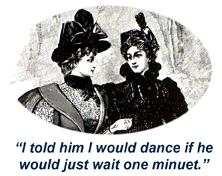
Shakespeare’s colleague and popular comic actor Will Kemp was famous for his stunt of dancing the jig from London to Norwich (about 80 miles). That’s what I think of when I see real estate ads boasting “only five minuets from downtown!”
This is one of those silly typos that your spelling checker won’t catch, because “minuet” is a real word.
Shakespeare’s colleague and popular comic actor Will Kemp was famous for his stunt of dancing the jig from London to Norwich (about 80 miles). That’s what I think of when I see real estate ads boasting “only five minuets from downtown!”
This is one of those silly typos that your spelling checker won’t catch, because “minuet” is a real word.
Subscribe to:
Posts (Atom)